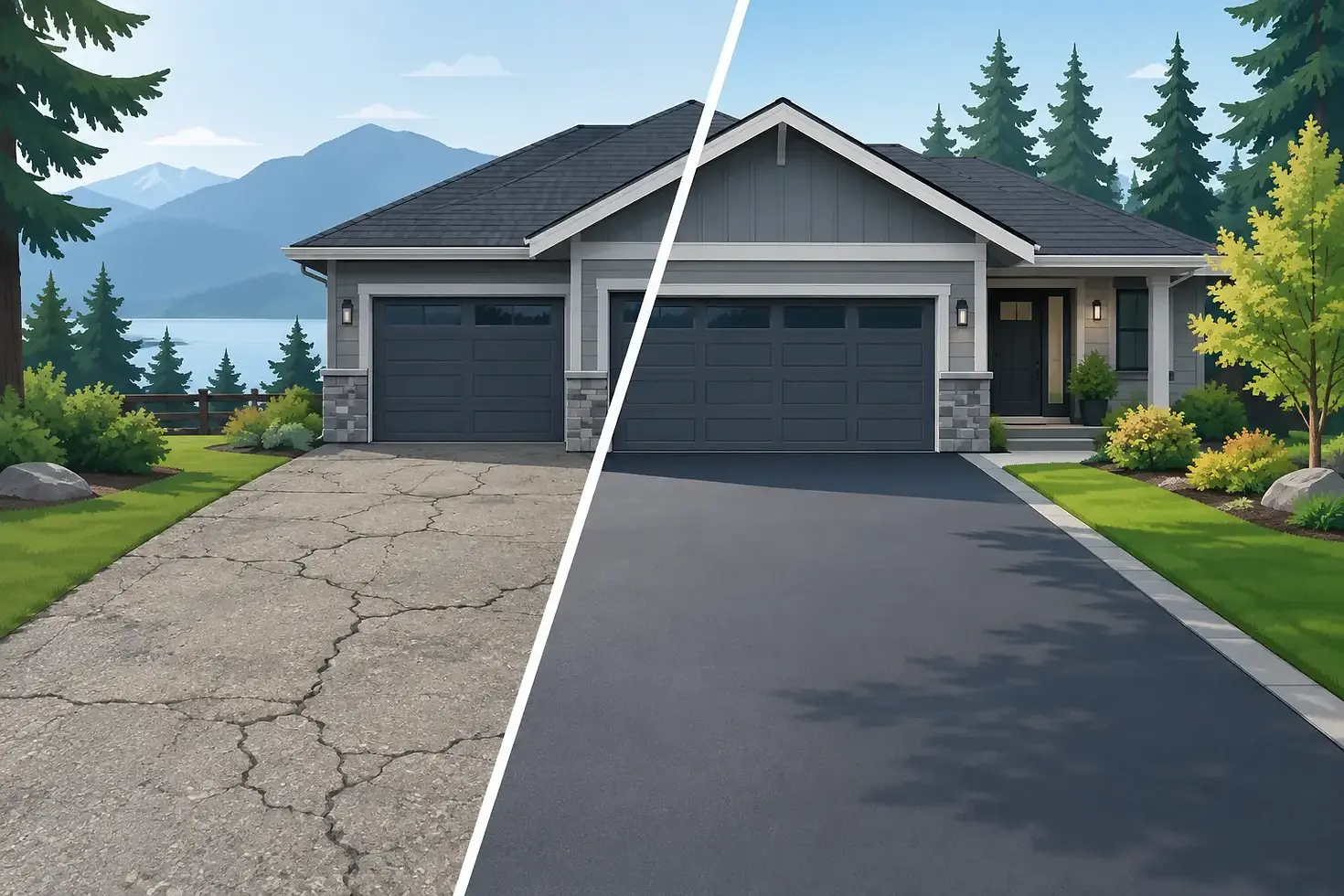
A Driveway Renovation Example for Northwest Homes
A driveway renovation example is more than replacing cracked pavement with a clean new surface. For a Snohomish County home, it can solve the daily frustrations hiding in plain sight: standing water by the garage, crumbling edges, a steep approach, limited parking, and an entry that does not match the rest of the property. The right renovation makes arriving home feel better while protecting the value of the investment beneath your tires.
The Property and the Problem
Consider a typical Northwest property with an aging asphalt driveway. The surface has settled near the garage, water gathers after heavy rain, and the outside edge breaks down where vehicles pull off to turn around. The front yard is attractive, but the faded driveway creates a hard visual line between the home and the street.
The owner does not simply need a new driving surface. They need a safer approach, room for a second vehicle, reliable drainage, and an entrance with enough presence to complement a well-kept home. That is where a professional driveway renovation becomes a design and site-planning project, not a patch job.
In this example, the existing driveway is removed and widened selectively near the garage and curb. The new layout creates a more comfortable turning radius without giving up unnecessary lawn. A defined walkway leads visitors toward the front door, while a decorative border separates planting areas from the driveway and gives the finished space a more intentional look.
Start Below the Surface
A beautiful driveway will not stay beautiful if the base, grade, and drainage are ignored. This is especially true in the North Puget Sound area, where long wet seasons expose every shortcut in the preparation work.
Before selecting a finish, the site should be evaluated for slope, runoff patterns, soft soil, existing concrete elevations, utility locations, and how vehicles actually move through the property. Water needs a planned path away from the garage and home foundation. In some cases, that means reshaping the subgrade; in others, it may call for a drain, catch basin, channel drain, or a carefully placed swale tied into the landscape design.
The base is just as important. After demolition, unstable material is removed as needed, the subgrade is compacted, and a properly prepared aggregate base is installed and compacted in lifts. The exact depth depends on site conditions and the intended use. A driveway that serves passenger cars has different needs than one used regularly by work trucks, RVs, trailers, or delivery vehicles.
This work is not the glamorous part of a renovation, but it is what supports the finished product. Alfa Industries approaches flatwork with the understanding that a premium surface starts with disciplined preparation. We design and build on what we promise, including the work clients may never see after the project is complete.
Choosing a Surface That Fits the Home
For this driveway renovation example, the owner chooses a concrete driveway with an exposed aggregate finish. The surface has visual depth, natural traction, and a finish that complements a Pacific Northwest home without looking overly formal. Saw-cut control joints create clean panels and help manage normal concrete movement.
A charcoal-toned paver border is added along the main edges and around the front walk connection. The contrast frames the concrete, adds a custom detail visible from the street, and creates a transition that feels connected to the landscape. The pavers are not used as an afterthought. Their pattern, elevation, and restraint details must work with the concrete layout from the beginning.
Concrete, asphalt, and interlocking pavers can all be strong choices. The best option depends on the property, budget, style, drainage plan, and maintenance expectations.
Concrete offers exceptional design flexibility. Homeowners can choose broom finishes, exposed aggregate, sandy finishes, color, decorative borders, and integrated walkways. It is a strong fit when the driveway is a major visual feature and the owner wants a more tailored appearance.
Asphalt can be a practical choice for long driveways or properties where budget and efficient coverage are the priority. It provides a clean, dark surface and can perform very well when the base and drainage are done correctly. It generally has fewer finish options than decorative concrete, and it benefits from periodic maintenance over its lifespan.
Interlocking pavers offer pattern, color, and repair flexibility. They can be especially effective for entry courts, borders, parking pads, and areas where a high-end architectural look is the goal. Their installation is more detail-intensive, so they are often best used strategically rather than across every square foot of a large driveway.
Building the Renovation in the Right Order
Once the plan is set, a well-managed project follows a clear sequence. First comes demolition and site protection. Existing pavement is removed, and adjacent landscaping, structures, and access areas are protected as practical. A professional team also keeps job-site safety and cleanup in focus, because construction should not create unnecessary stress for the household.
Next, the crew completes excavation, base preparation, and drainage work. This is the stage where elevations are confirmed. The driveway must meet the garage, street, walkways, and landscape areas with purposeful transitions. A surface that looks level can still be graded correctly to direct water where it belongs.
Forms establish the driveway shape, thickness, and edge lines. Reinforcement is installed where specified, and the crew coordinates features such as paver borders, curbs, steps, or integrated walkways before concrete arrives. These details are much easier to execute well when they are planned as one system.
The concrete placement is the moment the new driveway begins to take shape, but finish work demands patience. The crew places, levels, textures, joints, and protects the slab according to the selected finish and weather conditions. In the example project, exposed aggregate is revealed evenly, the border lines remain crisp, and the control-joint pattern aligns with the geometry of the home rather than cutting across it randomly.
After curing and final cleanup, the landscape edges are restored. Fresh planting, mulch, low-voltage lighting, or a rebuilt lawn edge can make the difference between a new driveway and a complete arrival experience.
What Changes the Scope and Investment
Two driveways with the same square footage can have very different project requirements. A relatively flat site with good existing drainage may need straightforward removal, base work, and replacement. A sloped lot with failing edges, drainage issues, retaining needs, or limited access requires more planning and labor.
The biggest scope factors usually include demolition thickness, excavation depth, soil conditions, drainage improvements, driveway size, selected material, finish complexity, access for equipment, and details such as borders, steps, walls, or landscaping. A wider driveway may improve daily parking, but it also increases material and drainage considerations. Decorative finishes create a stronger curb appeal payoff, yet they require careful layout and skilled execution.
There is also a practical decision around how much of the property to renovate at once. Some homeowners replace only the failing driveway and preserve surrounding features. Others combine the project with a new front walk, retaining wall, patio, or landscape transformation so the entire exterior feels cohesive. Neither approach is automatically better. The right choice depends on the condition of the site, the long-term plan for the home, and the experience the owner wants every day.
The Finished Result Should Work as Hard as It Looks
In this example, the homeowner gains a driveway that drains with intention, accommodates vehicles more comfortably, and gives the front of the home a finished, high-value appearance. The exposed aggregate surface feels substantial underfoot, the paver border provides a custom visual signature, and the connected walkway makes the route to the front door clear and welcoming.
That is the real opportunity in a driveway renovation. It can turn a worn-out necessity into a durable, low-maintenance feature that improves safety, usability, curb appeal, and pride in the property.
If your driveway has settled, cracked, puddled, or simply stopped reflecting the quality of your home, start with a custom design conversation. A thoughtful site review can reveal whether the best next move is concrete, asphalt, pavers, drainage improvements, or a complete front-entry transformation built around the way you live.



Comments